Standing water in the yard, a wet basement, a slope that keeps washing out, or a driveway culvert that's given up? Water always wins the long game — but only if you let it run wild. We walk the ground, figure out exactly where the water comes from and where it wants to go, then build the drainage to send it there for good. Free, in-person estimates across St. James, Rolla and Phelps County.
Between the clay-heavy soils and the rolling Ozark terrain around here, water is a constant fight. It sheds off hills fast, ponds on flat clay that won't soak it up, and finds the lowest path across your property — which is too often your yard, your driveway or the wall of your house. MB General Contracting is a licensed general contractor based in St. James, and drainage is one of the things we get called on most. We solve the problem at its source: reshaping the ground so it sheds water the way it should, then installing the right combination of drains, culverts and swales to carry that water off your property and away from anything it can damage.
Owner-operator Matthew Buhlinger has spent 15-plus years reading dirt and moving it, and drainage is where that experience really pays off. Anybody can dig a trench and drop in pipe. The trick is knowing where the water actually goes during a hard rain, what the local soil will and won't do, and how to grade a site so gravity does most of the work. We own the excavators, dozers and skid steers to do it right, and because we pour our own concrete in-house, we can tie drainage into flatwork, aprons and footings without waiting on another crew.
Drainage isn't one product; it's picking the right tool for the water problem in front of you. Here's the range of work we handle, and what each piece is actually for:
A bag of mulch over a wet spot, or a splash block under a downspout, hides the problem for a week. Standing water and washouts are almost always a grade-and-flow problem — the ground is sending water the wrong way. We correct the grade and give the water a path, so the fix holds instead of coming back every spring.
Drainage ties into driveway grading, retaining walls, concrete and excavating. Building them together with one crew means the whole site is set up to drain correctly from day one — not patched later once the water shows you what got missed.
Drainage advice from a flat, sandy part of the country doesn't translate to Phelps County. Two things drive nearly every water problem we see here. First, the soil: a lot of our ground is heavy clay with a thin layer of topsoil, and clay does not absorb water well. During a downpour it sheds almost everything at the surface, and once it's saturated it stays wet for days — which is exactly why a "low spot" turns into a pond that lingers long after the rain stops.
Second, the terrain. This is rolling Ozark-plateau country — hills, slopes and creek bottoms, with plenty of chert and rock not far under the surface. Water moves fast down a slope and collects hard at the bottom, so a house or driveway sitting mid-slope catches everything coming from above. In and around Rolla you'll hit rock quickly on the hilly ground and in the newer edge subdivisions where the natural grade got cut and filled during construction. Here in St. James and out on the surrounding rural acreage, long gravel drives, farm ground and older homes without modern foundation drainage are the common culprits. Down toward Waynesville and the Roubidoux, the bluffy terrain and creek-bottom flats make grading and drainage the difference between a usable yard and a swamp. Knowing which of these you're dealing with — clay that won't drain, rock you can't dig through cheaply, or a slope funneling water at you — is half the job, and it's why we walk the ground before we ever quote a fix.
Water rarely announces itself politely. If you're seeing any of these, the grade or flow on your property needs attention:
Catch these early and the fix is usually straightforward. Ignore them and water works its way into foundations, footings and slabs where the repair gets a lot bigger.
Straightforward, on-site, and built around what the water is actually doing.
Tell us what you're seeing — the wet basement, the pond in the yard, the washing drive. We set a time to come look.
We walk the property, find where water enters, collects and needs to go, and lay out the simplest fix that solves it for good.
Our crew and our own equipment reshape the grade and install the drains, culverts, swales or rock the job calls for.
We grade it back smooth, seed or dress disturbed ground, and leave the site clean with the water headed where it should.
Every property drains differently, so we quote after we've seen it. That said, these are the factors that move a drainage job up or down in price:
We'll always talk through the trade-offs on site so you understand what's driving the number and where there's a simpler option.
We're based right here in St. James and we own the excavators, dozers and skid steers the work takes. No subs, no waiting — the same crew that diagnoses your water problem is the one that fixes it, and we pour our own concrete if the job needs a basin, apron or slab.
Matthew has spent 15-plus years moving dirt across Phelps County and knows how local clay and slopes behave in a hard rain. That's the difference between a drain that works and a trench that fills up. We're a licensed general contractor and every estimate is free and in person.
Usually a combination of regrading the low areas and adding a swale or French drain to carry the water out to a safe outlet. On clay ground the soil won't soak it up, so the answer is almost always giving the water a shaped path to leave rather than trying to make it drain straight down. We'll pinpoint the cause on site and recommend the simplest fix that actually works.
It starts with grade: the ground for the first several feet around the house needs to slope away from it, not toward it. From there we add downspout lines that carry roof water well clear of the wall, and where needed a perimeter or footing drain that routes seep water to daylight. Fixing the grade and the roof water solves the majority of wet-basement calls we get.
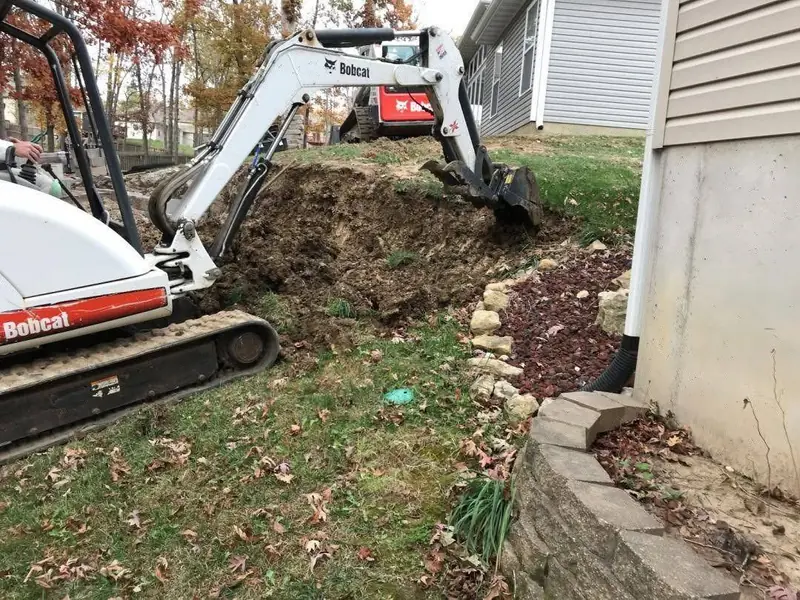
Yes. We control erosion by correcting the grade so water isn't allowed to run in a concentrated stream, then armoring the ground with rock or riprap and drainage where it's needed. On steeper ground a retaining wall may be the right call to hold the slope, and a properly crowned and ditched driveway grade keeps a gravel drive from washing out.
It depends on where the water is. Surface drainage — regrading and swales — is for water sitting on top of the ground. A French drain is for subsurface or seep water and for pulling water away from foundations and persistent wet spots below grade. Many yards need a bit of both, and we'll tell you honestly on site which one your problem calls for instead of overbuilding.
If your drive crosses a ditch or the natural path water takes along the road, yes — a correctly sized culvert lets that water pass under the drive instead of over it or backing up behind it. We size and set the pipe and re-cut the ditch so runoff keeps moving and your access stays passable. It often gets handled together with driveway grading.
It will, but the design has to respect the ground. Because our clay doesn't absorb water, we lean on surface grading, swales and piped runs that carry water off to daylight rather than expecting it to soak in. Rock affects how we dig and route the trench. This is exactly the kind of Ozark ground we work in every week, so we design around it rather than fighting it.
That's the ideal way to do it. If we're on site for excavating, a new drive or a wall, building drainage into the same job is more efficient and makes sure everything is set up to shed water correctly from the start. One crew, one mobilization, one grade that all works together.
Yes. Every drainage estimate is free and done in person, because we genuinely can't quote water without seeing where it goes. We serve St. James, Rolla and the surrounding Phelps County towns — call or text (573) 728-2550 and we'll set a time to come look.
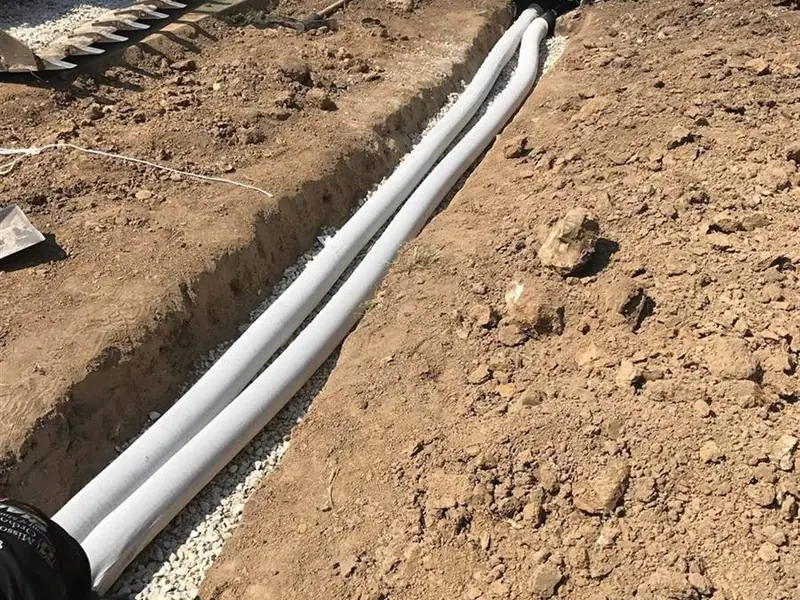
Trenched, gravel-bedded lines that carry water where it belongs.
Free, in-person estimates on drainage and erosion control across St. James, Rolla & Phelps County.